
For many private foundations, the journey begins with a simple desire to give back. Checks are written to worthy causes, grant applications are reviewed as they arrive, and funding decisions are made based on immediate needs and compelling stories. This reactive approach to philanthropy, while well-intentioned, often leaves foundation leaders wondering: Are we truly making the difference we hoped to achieve?
The transition from general charitable giving to focused, strategic philanthropy represents one of the most significant evolutions a foundation can undertake. It's a shift that requires courage, patience, and a willingness to fundamentally rethink how grantmaking decisions are made. Yet for foundations that successfully navigate this transformation, the rewards are substantial: deeper community impact, more efficient use of resources, and a clearer sense of purpose that energizes both staff and stakeholders.
This guide draws on interviews with foundation directors who have successfully pivoted their organizations toward strategic, outcome-oriented grantmaking. Their experiences illuminate both the challenges and opportunities that await foundations ready to embrace a more focused approach to philanthropy.
Understanding the Strategic Shift: Why Focused Philanthropy Matters
Strategic philanthropy isn't about being less generous or more restrictive—it's about being more intentional. When foundations move from reactive grantmaking to strategic focus, they're making a conscious decision to concentrate resources where they can achieve the greatest impact rather than spreading funding thinly across numerous causes.
"We were funding 150 organizations annually, but when we honestly assessed our impact, we couldn't point to any transformative change we'd helped create. We were a mile wide and an inch deep."
— Margaret Chen, Executive Director, Riverside Community Foundation
Margaret's foundation serves as a compelling case study. After twenty years of responsive grantmaking, the board initiated a strategic planning process that would fundamentally reshape their approach. The transition wasn't easy—it meant saying no to worthy organizations and disappointing long-time grantees. But three years into their focused strategy on youth education and workforce development, the foundation can now demonstrate measurable improvements in high school graduation rates and job placement outcomes across their target communities.

The benefits of strategic focus extend beyond measurable outcomes. Foundation staff report greater clarity in decision-making, more meaningful relationships with grantees, and increased ability to leverage partnerships. Board members find their governance role more engaging when they're tracking progress toward specific goals rather than simply reviewing grant applications. And perhaps most importantly, communities benefit from sustained, coordinated investment in addressing root causes rather than temporary relief of symptoms.
However, strategic philanthropy requires foundations to develop new capabilities. Instead of responding to incoming requests, foundations must proactively identify community needs, develop theories of change, engage stakeholders in meaningful ways, and build systems for measuring progress. These skills don't develop overnight, and the transition period can feel uncomfortable for organizations accustomed to more traditional grantmaking approaches.
Conducting Comprehensive Needs Assessment: The Foundation of Strategic Focus
Before a foundation can focus its grantmaking, it must understand the landscape of community needs. This requires moving beyond anecdotal information and gut feelings to gather systematic data about challenges, assets, and opportunities within the communities you serve.
Quantitative Data Collection Methods
Start by examining existing data sources. Census information, public health statistics, educational achievement data, economic indicators, and social service utilization rates provide objective baselines for understanding community conditions. Many foundations partner with local universities or research organizations to analyze these data sources and identify trends, disparities, and emerging issues.
Essential Data Sources for Needs Assessment
- U.S. Census Bureau demographic and economic data
- County and state health department statistics
- School district performance metrics and graduation rates
- Local workforce development and employment data
- Housing affordability and homelessness statistics
- Crime rates and public safety indicators
- Environmental quality and access to green space
- Food security and nutrition program utilization
The Westfield Foundation took this approach when beginning their strategic planning process. They commissioned a comprehensive community indicators report that examined 50 different metrics across health, education, economic opportunity, and civic engagement. This data revealed surprising patterns—while overall poverty rates were declining, childhood poverty was increasing in specific neighborhoods. This insight led the foundation to focus their strategy on early childhood development and family economic stability.
Qualitative Research and Community Voice
Numbers tell only part of the story. Strategic foundations complement quantitative data with qualitative research that captures community perspectives, lived experiences, and local knowledge. Focus groups, individual interviews, community forums, and surveys provide rich insights into how residents understand challenges and envision solutions.

James Rodriguez, who led the strategic transition at the Mountain Valley Foundation, emphasizes the importance of this qualitative work: "We held 30 listening sessions across our region, talking with everyone from social service clients to business leaders to faith community representatives. What we learned completely changed our assumptions about what our community needed most. The data said housing, but the people said transportation—they couldn't get to jobs, healthcare, or services because of inadequate public transit."
Effective qualitative research requires careful attention to whose voices are being heard. Foundations must make deliberate efforts to engage populations that are often underrepresented in community planning processes: low-income residents, people of color, immigrants, people with disabilities, and youth. This may require offering childcare, providing interpretation services, meeting in accessible locations, and compensating participants for their time and expertise.
Developing Your Theory of Change: Mapping the Path to Impact
Once you understand community needs, the next step is developing a theory of change—a comprehensive explanation of how your foundation's investments will lead to desired outcomes. This framework articulates the logical connections between activities, outputs, outcomes, and ultimate impact, making explicit the assumptions underlying your strategy.
A theory of change is more than a logic model or program plan. It's a hypothesis about how change happens in complex social systems. It identifies the preconditions necessary for success, acknowledges the roles of multiple actors, and recognizes that achieving lasting impact requires addressing root causes rather than symptoms.
"Our theory of change forced us to be honest about what we could realistically accomplish. We couldn't solve homelessness alone, but we could focus on preventing homelessness among families with children by supporting rapid rehousing and eviction prevention programs."
— Patricia Williams, Board Chair, Lakeside Family Foundation
Key Components of an Effective Theory of Change
A robust theory of change includes several essential elements. First, it clearly defines the ultimate impact you seek to achieve—the long-term change in community conditions that represents success. This impact statement should be specific, measurable, and ambitious yet achievable within a reasonable timeframe.
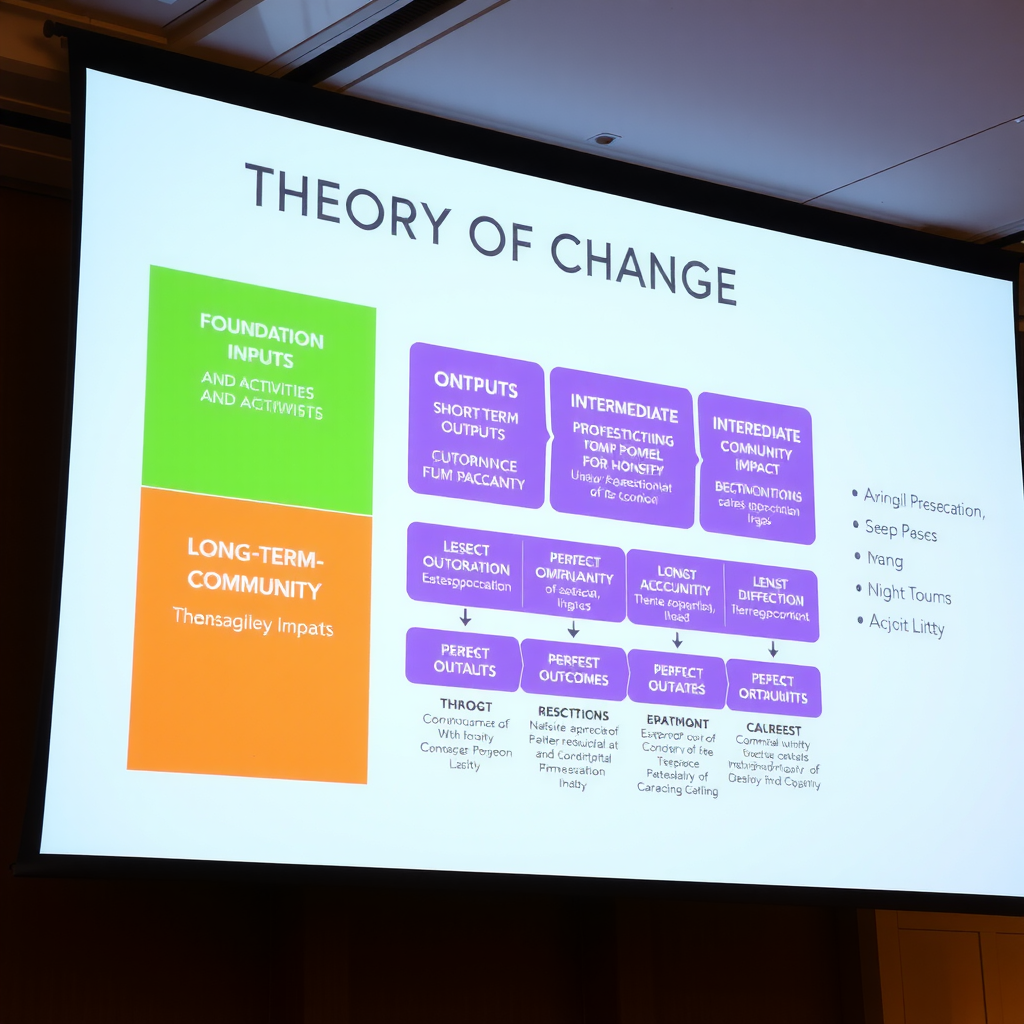
Next, identify the intermediate outcomes that must occur to achieve your ultimate impact. These are the changes in knowledge, attitudes, behaviors, or conditions that represent progress toward your goal. For example, if your impact goal is reducing childhood obesity, intermediate outcomes might include increased physical activity among children, improved nutrition in school meals, and greater access to healthy food in underserved neighborhoods.
Then specify the strategies and activities your foundation will support to produce these outcomes. This is where grantmaking decisions become concrete. What types of programs will you fund? What capacity-building support will you provide? What advocacy or systems change efforts will you champion? Each strategy should have a clear rationale explaining why you believe it will contribute to your desired outcomes.
Finally, articulate your assumptions—the beliefs about how change happens that underlie your theory. These might include assumptions about community readiness, availability of evidence-based practices, political will for policy change, or capacity of nonprofit partners. Making assumptions explicit allows you to test them over time and adjust your strategy when assumptions prove incorrect.
Engaging Stakeholders in Theory Development
The most effective theories of change are developed collaboratively with the communities and organizations you aim to support. The Harbor Foundation learned this lesson when their initial theory of change, developed primarily by board members and consultants, met with skepticism from local nonprofits who felt it didn't reflect ground-level realities.
They revised their approach, convening working groups of nonprofit leaders, community members, and subject matter experts to co-create their theory of change. This collaborative process took longer but resulted in a strategy with much stronger buy-in and more realistic assumptions about what could be achieved. As Executive Director Sarah Thompson reflects, "We thought we were slowing down by involving so many stakeholders, but actually we were building the foundation for faster implementation because everyone understood and supported the strategy."
Stakeholder Engagement: Building Partnerships for Strategic Success
Strategic philanthropy cannot succeed in isolation. Foundations must cultivate meaningful partnerships with nonprofit organizations, government agencies, business leaders, and community members. These relationships transform grantmaking from a transactional exchange into a collaborative effort to achieve shared goals.
Effective stakeholder engagement begins with transparency about your strategic direction. When foundations clearly communicate their priorities, nonprofits can make informed decisions about whether to pursue funding and how to align their work with foundation goals. This transparency also helps manage expectations and reduces frustration from organizations whose missions fall outside your focus areas.

Creating Authentic Partnership Structures
The Riverside Community Foundation established a Community Advisory Council composed of nonprofit leaders, residents with lived experience of the issues they address, and representatives from sectors like education, healthcare, and business. This council meets quarterly to provide input on strategy implementation, review progress data, and identify emerging needs or opportunities.
Council members receive stipends for their participation, recognizing that their expertise and time have value. The foundation also provides professional development opportunities for council members, strengthening their leadership capacity while deepening their engagement with the foundation's work. This investment in relationship-building has paid dividends through more effective grantmaking, stronger community connections, and valuable feedback that has improved foundation operations.
Other foundations have created learning communities where grantees working on similar issues meet regularly to share strategies, troubleshoot challenges, and identify opportunities for collaboration. These convenings serve multiple purposes: they build nonprofit capacity, foster peer learning, create opportunities for collective action, and provide foundations with deeper insight into implementation challenges and successes.
Managing the Transition with Current Grantees
One of the most challenging aspects of moving to strategic focus is communicating with organizations that have received funding in the past but fall outside your new priorities. This requires both honesty and compassion. Foundations should provide as much advance notice as possible, clearly explain the rationale for strategic changes, and when feasible, offer transition funding to help organizations adjust.
Best Practices for Transition Communication
- Announce strategic changes at least 12-18 months before implementation
- Offer individual meetings with affected grantees to discuss the transition
- Provide resources to help organizations identify alternative funding sources
- Consider offering final grants that are larger or longer-term to ease transition
- Maintain relationships even when funding ends—offer technical assistance or connections
- Be transparent about decision-making criteria and timeline
- Acknowledge the difficulty of the transition and express genuine appreciation for past partnership
The Mountain Valley Foundation handled this transition with particular grace. They created a "transition fund" specifically to support organizations moving out of their funding portfolio, offering 18 months of continued support plus access to fundraising consultation and donor introductions. While this approach required additional resources, it preserved relationships and maintained the foundation's reputation as a trustworthy partner in the nonprofit community.
Aligning Funding Priorities with Authentic Community Needs
The ultimate test of strategic philanthropy is whether funding priorities genuinely reflect community needs rather than donor preferences or foundation assumptions. This alignment requires ongoing attention, humility, and willingness to adjust course based on feedback and results.
Many foundations discover gaps between their initial strategic priorities and what communities actually need. The Westfield Foundation, mentioned earlier, provides a cautionary tale. Their data analysis suggested focusing on early childhood education, and they developed an elaborate strategy around pre-K programs. However, deeper community engagement revealed that many families couldn't access these programs due to work schedules, transportation barriers, and lack of awareness. The foundation had to pivot their strategy to address these access issues before their education investments could achieve intended impact.

Flexible Funding and Trust-Based Philanthropy
Strategic focus doesn't mean rigid adherence to predetermined plans. The most effective strategic foundations balance clear priorities with flexibility in how those priorities are pursued. They provide general operating support rather than restricting grants to specific programs, recognizing that nonprofit leaders understand their organizations' needs better than funders do.
Trust-based philanthropy principles complement strategic focus beautifully. By streamlining application processes, providing multi-year funding, and reducing reporting burdens, foundations free nonprofits to focus on their mission rather than grant compliance. The Harbor Foundation reduced their grant application from 25 pages to 5 pages and eliminated interim reports for grants under $50,000. This shift didn't reduce accountability—it simply recognized that the best accountability comes from strong relationships and meaningful outcome measurement rather than bureaucratic paperwork.
"When we started providing unrestricted, multi-year funding, our grantees told us it was transformational. They could invest in staff development, build reserves, and plan strategically instead of lurching from grant to grant. And ironically, we saw better outcomes because organizations were more stable and effective."
— David Martinez, President, Coastal Impact Foundation
Measuring What Matters
Strategic philanthropy requires measuring progress toward goals, but measurement systems must be designed thoughtfully to avoid creating burdens that outweigh benefits. The best measurement approaches focus on a small number of meaningful indicators rather than tracking everything possible. They use existing data sources when available rather than requiring grantees to collect new data. And they recognize that some of the most important outcomes—like increased community trust or strengthened relationships—may be difficult to quantify but still deserve attention.
The Lakeside Family Foundation developed a "learning agenda" that guides their evaluation efforts. Rather than measuring every activity, they identified key questions they needed to answer to improve their strategy: Are we reaching the most vulnerable families? Are our grantees able to sustain programs after our funding ends? What barriers prevent families from accessing services? They designed data collection specifically to answer these questions, making evaluation more focused and useful.
Importantly, strategic foundations share evaluation findings transparently, including when results are disappointing. This transparency builds trust with grantees and community partners, demonstrates accountability to stakeholders, and contributes to the broader knowledge base about what works in addressing social challenges. The willingness to acknowledge failures and learn from them distinguishes truly strategic foundations from those simply going through the motions of strategic planning.
Moving Forward: Your Foundation's Strategic Journey
The transition from reactive to strategic philanthropy is not a one-time event but an ongoing journey of learning, adaptation, and growth. It requires patience—meaningful change takes time, and foundations must resist the temptation to abandon strategies before they've had adequate time to demonstrate results. It requires humility—acknowledging that foundations don't have all the answers and that community wisdom must guide strategy. And it requires courage—making difficult decisions about focus areas, saying no to worthy causes, and staying committed to long-term goals despite short-term pressures.
For foundation leaders contemplating this transition, the experiences of those who have gone before offer both inspiration and practical guidance. Start with genuine community engagement—listen more than you talk, and let community voices shape your priorities. Develop a clear theory of change that makes your assumptions explicit and provides a framework for learning. Build authentic partnerships with grantees and community stakeholders, recognizing that collaboration multiplies impact. Provide flexible, trust-based funding that respects nonprofit expertise and reduces administrative burden. And measure what matters, using evaluation to learn and improve rather than simply to demonstrate success.
The Path Forward
Strategic philanthropy isn't about perfection—it's about intentionality, learning, and commitment to creating lasting change. Every foundation's journey will be unique, shaped by its history, resources, and community context. But the destination—deeper impact, stronger partnerships, and more meaningful contribution to community wellbeing—makes the journey worthwhile.
The foundations profiled in this guide demonstrate that strategic focus enhances rather than limits philanthropic impact. By concentrating resources, building deep expertise in specific issue areas, and committing to long-term engagement, they achieve results that scattered, reactive grantmaking could never accomplish. Their experiences prove that strategic philanthropy, grounded in community needs and guided by authentic partnerships, represents the future of effective foundation leadership.
As you embark on or continue your foundation's strategic journey, remember that you're not alone. A growing community of practice supports foundations making this transition, offering resources, peer learning opportunities, and encouragement. The path from reactive to strategic philanthropy may be challenging, but it leads to more effective grantmaking, stronger community relationships, and ultimately, the lasting impact that inspired your foundation's creation.

About the Author
Foundation Development Specialist
This article draws on interviews with foundation leaders and research conducted by The Albert Kim Foundation's strategic philanthropy initiative. For more resources on foundation development and strategic grantmaking, visit our resource library or contact our team for consultation services.